
VAE in Practice: What to Expect in the Timeline, Evidence, and Review Stages
If you want the plain version first, here it is: a VAE journey usually feels much less mysterious once you break it into five jobs instead of one giant life-admin cloud.
Published June 20, 2026. Updated June 20, 2026. By Nora Finch.
Most people who arrive here are asking some version of the same questions: How long might a VAE take in real life? What counts as useful evidence and what is just optimistic clutter? What happens when someone finally reviews the dossier I spent all weekend naming very seriously?
The official VAE portal, the French public-service guide to validation des acquis de l’experience, and the Europass overview of validation of non-formal and informal learning all point to the same basic truth: VAE is a structured way to turn experience into recognised proof, and structure matters because experience on its own is not yet a dossier. The process is not only about what you have done. It is about what you can explain, document, and connect to the qualification you are targeting.
I like to think of this article as a quick map you can actually use. By the end, you should know what the main stages look like, where timelines often stretch, how to choose evidence that helps instead of overwhelms, and when it makes sense to keep going alone or ask for support through the VAE page, the coaching page, or the site’s blog.

Quick overview: what VAE is really doing
VAE, or validation des acquis de l’experience, is a process that can help a candidate seek formal recognition for skills and knowledge already built through work, volunteering, or other substantial experience. The short answer is that VAE tries to answer one question: does this person’s experience match the level and scope of the qualification they are pursuing?
That sounds tidy on paper, but the lived version is more practical. A candidate usually has to:
- identify the right target qualification or certification,
- confirm they are a realistic fit for that target,
- collect evidence that shows what they actually did,
- write a dossier that links experience to expected competencies, and
- prepare for review, feedback, and sometimes an oral presentation.
VAE is not a memory contest and it is not a victory lap. It is a matching exercise between your real experience and a framework someone else will review. That is why good preparation usually matters more than impressive adjectives.
Terminology that makes the rest of the process easier
- Target qualification: the diploma, title, or certification you want your experience to support.
- Eligibility or admissibility: the early check that asks whether your experience appears relevant enough to proceed.
- Evidence: the documents, work samples, records, references, or explanations that support what you claim.
- Dossier: the structured file where you present experience, proof, and reflection in a reviewable format.
- Review panel or jury: the people who assess whether the dossier demonstrates the required competencies clearly enough.
If you are new to this language, that is normal. Most people do not spend their spare time casually discussing dossier structure over coffee. The good news is that once you know the labels, the process becomes less foggy very quickly.
A realistic timeline: the five stages at a glance
| Stage | Main job | What often affects the timeline |
|---|---|---|
| 1. Eligibility and scope | Choose the target and confirm your experience broadly fits. | How clear the target is and how easy it is to describe your background. |
| 2. Evidence planning | Decide which experiences and proof points are worth documenting. | How scattered your records are and whether your examples are easy to verify. |
| 3. Writing the dossier | Turn real work into clear written evidence linked to competencies. | Writing time, document gaps, revision cycles, and how specific you can be. |
| 4. Review and feedback | Respond to questions, clarify points, and adjust where needed. | The review body’s calendar and how quickly you can provide clarifications. |
| 5. Oral presentation | Explain your dossier out loud if that step applies. | Your preparation, the review format, and how focused your examples are. |
In practice, some candidates move through the early stages in a few weeks, while others spend several months because they are still choosing the target, tracking down old documents, or rewriting vague examples into something usable. The more ready your evidence is at the start, the less the process behaves like a scavenger hunt.
Stage 1: eligibility and scope
The first stage is less glamorous than people expect, which is exactly why it matters. Before you write anything long, you need to know what you are aiming at and whether your experience genuinely aligns with it.
I would treat this stage like a calibration exercise. You are not yet proving everything. You are checking whether the target makes sense.
What you are trying to confirm
- The target is specific enough. “I want recognition in management” is too broad. “I want to pursue a qualification tied to the work I have already done leading a team, planning activity, and coordinating delivery” is more usable.
- Your experience is relevant, not merely adjacent. Being close to a function is not the same as performing it. Watching project plans happen from nearby does not usually count as project management experience.
- You understand the scope. Reviewers are not only asking whether you have been busy. They are asking whether your experience demonstrates the expected competencies of the qualification.
A useful external reference here is the France competences certification search, because it helps you see how specific the target itself may need to be. VAE gets easier when the target is narrow enough to compare against, but broad enough to match the work you really did.
A simple fit test
Try answering these four questions in writing:
- What qualification or certification am I targeting?
- Which parts of my experience line up with it most clearly?
- Where might a reviewer say, “That is related, but not quite the same thing”?
- What documents or examples could support my broad fit before I start full drafting?
If question three produces a long nervous silence, that is not failure. It is useful information. Better to notice the mismatch now than after writing twenty pages about the wrong target.
Imagine Lea, who has spent years coordinating schedules, suppliers, and reporting for a busy department. If she targets a qualification tied to operational coordination, her examples may line up well. If she targets something that assumes deeper budgeting authority or formal people management she never held, the dossier becomes harder to defend. Close enough is not always enough.
Stage 2: evidence planning
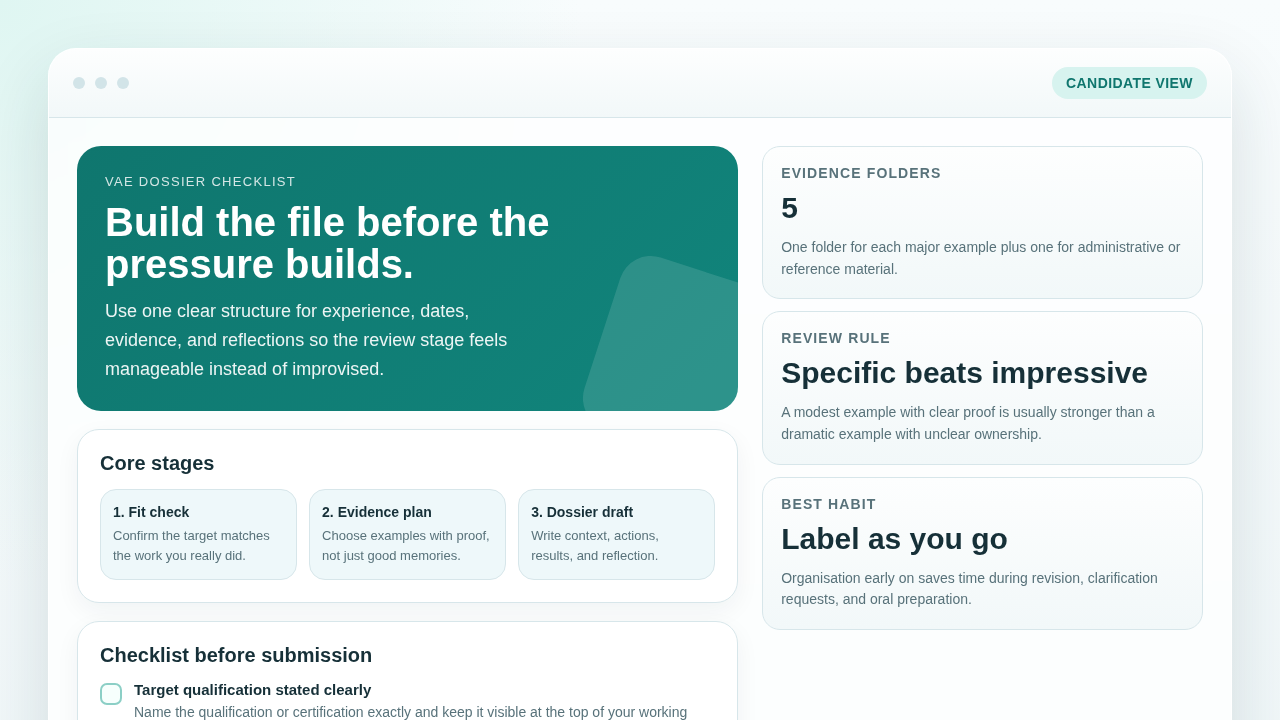
This is the stage that saves candidates from drowning in paper later. Once the target is reasonably clear, the next job is to choose the experiences that best show the right competencies, then decide what proof can support them.
Evidence planning is not about including everything you have ever done. It is about selecting the examples that make the strongest case. If your dossier starts to resemble the contents of a drawer labelled “important probably,” pause and narrow it down.
What useful evidence often looks like
- Job descriptions or mission statements that show your role and responsibilities.
- Project documents such as plans, reports, summaries, or meeting outputs that show your contribution.
- Deliverables or work products that can be shared safely and appropriately.
- Timelines, evaluations, or references that help anchor dates, duration, and level of responsibility.
- Your own explanation of the context, decisions, constraints, and outcomes around the work.
The last item matters more than it sounds. A document rarely speaks for itself. A reviewer needs to understand what the situation was, what you personally did, and why the example demonstrates the competency you claim.
Common mismatches to avoid
- Choosing famous projects instead of relevant projects. A high-profile initiative is not automatically your best example if your role in it was limited.
- Confusing team output with personal contribution. Reviewers need to know what you did, decided, coordinated, or improved.
- Skipping dates and duration. Time matters. A task you handled once is not the same as responsibility you carried consistently.
- Relying on generic praise. “Reliable,” “versatile,” and “dynamic” may be true, but they are not evidence.
One practical trick is to build an evidence grid before writing full paragraphs. Use four columns: experience, competency shown, proof available, proof missing. The grid makes gaps visible early, and visible gaps are much easier to solve than vague worry.
Stage 3: writing your dossier
Now the real writing starts. For many candidates, this is the longest stage because it asks for two things at once: accurate memory and clear structure. You are not only listing tasks. You are building an argument.
I find the simplest framework is also the most reusable:
- Context: What was the situation? What was the setting, objective, or problem?
- Actions: What did you personally do?
- Results: What changed, improved, or got delivered?
- Reflection: What did this example show about your level of responsibility, judgment, or competence?
Context, actions, results, reflection. If a paragraph is missing one of these, it often feels thin for a reason.
An example of the difference structure makes
Too vague: “I coordinated a major service change and supported the team during implementation.”
Clearer: “During a service transition affecting three departments, I built the rollout schedule, tracked dependencies between teams, updated weekly reporting, and resolved supplier delays that threatened the launch date. The process reduced last-minute escalation and made responsibilities easier to follow. This example shows my ability to organise activity, manage coordination constraints, and maintain continuity under pressure.”
The second version is not dramatic, but it is much easier to assess. It gives the reviewer something to work with.
Tips for writing clearly
- Name your role early. Do not make the reviewer guess whether you led, supported, monitored, or approved the work.
- Use concrete verbs. Coordinated, analysed, scheduled, trained, redesigned, documented, negotiated. Clear verbs beat cloudy ones.
- Anchor the example in time. Include duration, sequence, or frequency where relevant.
- Explain the why. What problem did the work solve? Why did your action matter?
- Keep the claim proportional. Strong evidence is persuasive. Overclaiming makes every sentence less trustworthy.
Expect revision here. Almost everyone writes a first version that is either too short, too broad, or too close to CV language. That is normal. A dossier is not a resume wearing a more serious shirt. It needs more explanation and more direct links between work and competencies.
Stage 4: review and feedback
Once the dossier is submitted, the process shifts from writing mode to review mode. This is the point where candidates often become anxious because the work is no longer fully in their hands. That feeling is understandable, but it helps to remember what review is for.
Reviewers are usually trying to assess clarity, relevance, and consistency. They want to know whether the dossier demonstrates the expected competencies in a credible, well-supported way. They may look for:
- whether the examples match the qualification scope,
- whether your role is explicit,
- whether the evidence is detailed enough to support your claims,
- whether dates, responsibilities, and outcomes make sense together, and
- whether the dossier shows reflection rather than copied task lists.
How to respond if clarification is requested
If you are asked to clarify something, treat that request as useful guidance, not as a secret sign that everything has collapsed. Often the issue is one of detail or linkage.
- Answer the exact point raised. Do not rewrite unrelated sections out of panic.
- Add specifics. Dates, scale, decisions, and personal actions usually help more than new adjectives.
- Reconnect the example to the competency. Make the logic explicit.
- Stay factual. Defensive tone rarely improves a dossier.
Imagine a reviewer asks, “Can you clarify your role in this project?” That does not always mean the project is weak. It may simply mean the team context is clear but your individual contribution is still blurry. A short, direct addition can fix that much more effectively than three extra paragraphs of background.
Feedback is easier to use when your documents are organised. If every supporting item is already labelled and easy to find, you can respond quickly instead of reopening ten old folders and a small emotional weather system.
Stage 5: oral presentation, if it applies
Some candidates will also have an oral step. If that applies to your route, think of it as a conversation that tests whether the written dossier reflects real, understood experience.
The goal is not to perform confidence. The goal is to explain your examples clearly and credibly.
What helps in practice
- Choose two or three anchor examples. These should cover substantial work you can explain from start to finish.
- Tell each example as a sequence. Situation, action, result, reflection. The same structure works out loud.
- Prepare to explain choices. Why did you do it that way? What constraint were you managing? What did you learn?
- Practice plain answers. Clear and steady is better than impressive and over-rehearsed.
Nerves are common, especially if you have spent weeks writing and now have to talk about the same material without sounding like you swallowed a spreadsheet. Try a simple rehearsal rule: explain one example to someone else in under three minutes, then answer two follow-up questions. If your explanation survives that test, it is usually heading in the right direction.
Common pitfalls that slow candidates down
Most VAE problems are not dramatic. They are small, repeated mistakes that make the file harder to trust.
- Vague role descriptions. If the reviewer cannot tell whether you led the work, assisted it, or observed it, the example weakens quickly.
- Missing dates and sequence. Timelines help prove continuity and responsibility.
- Weak cause and effect. “I participated” is not the same as showing what your participation changed.
- Overclaiming outcomes. If the result sounds bigger than the evidence, the whole dossier becomes less credible.
- Document overload. Too many loosely connected attachments can be as unhelpful as too few.
- Leaving organisation to the end. Label files early, keep one naming system, and track where each document supports the dossier.
A good dossier feels traceable. A reviewer should be able to follow the logic from competency to example to supporting material without detective work.
Practical checklist: what to gather before you start
| Category | What to collect | Why it helps |
|---|---|---|
| Role history | Job titles, dates, employers, mission summaries, volunteering roles if relevant. | Creates the timeline backbone of the dossier. |
| Project evidence | Reports, plans, schedules, deliverables, presentations, process notes, safe work samples. | Shows what you actually handled or produced. |
| Responsibility proof | Letters, evaluations, role descriptions, references, internal documentation. | Helps verify scope and level of responsibility. |
| Reflection notes | Short notes on context, actions, decisions, outcomes, lessons learned. | Makes writing easier because you are not reconstructing everything from scratch later. |
| Organisation tools | A folder system, naming convention, and one tracking sheet for evidence. | Reduces chaos during drafting and review. |
If you prefer a short starter list, begin here:
- Write the target qualification at the top of a page.
- List three experiences that match it best.
- For each one, note the proof you already have and the proof you still need.
- Gather dates, documents, and names while they are still easy to find.
- Create one folder per example and label everything before the pile grows teeth.
This is also the stage where some candidates realise they need support not because they lack experience, but because they need help narrowing, structuring, and writing it. That is a very different problem, and thankfully a much more solvable one.
Next steps: should you proceed alone or seek support?
A simple decision rule helps here.
- Proceed mostly independently if your target is clear, your examples are strong, your documents are already fairly organised, and you are comfortable turning experience into structured writing.
- Seek coaching or guided support if you are still unsure about the right target, your evidence exists but feels messy, or every draft sounds like a job description with stage fright.
- Ask for a first conversation if you can explain the goal but want help checking fit, workload, or sequence before committing fully.
If you want broader context first, the home page gives the larger site picture. If you already know VAE is the route you want to explore, the dedicated VAE page is the most direct next stop. If you suspect the real need is target clarity before formal recognition, the coaching page may be the better first move. And if you want a personalised conversation, use the contact page.
The short version
VAE works best when you treat it as a staged process: confirm fit, choose evidence carefully, write with structure, respond to review calmly, and prepare to explain your work clearly if an oral step applies. Timelines vary, but the pattern is consistent. The more specific and organised your evidence is, the more manageable the journey becomes.
If you were hoping for a magic shortcut, I will be annoyingly honest: the process still asks for work. But it is usually much more doable once the work has names, order, and a checklist. That is often the point where anxiety starts to shrink and progress starts to look like something real.